The Indian Police Service , simply known as Indian Police or IPS, is one of the three All India Services civil services of the Government of India.In
1948, a year after India gained independence from Britain, the Imperial
Police (IP) was replaced by the Indian Police Service.
The IPS is not a law enforcement agency; rather it is a civil service in which officers are selected on the basis of professional merit as proven by competitive examinations, and to which all senior police officers are professionally identified. Police officers are employed by the police departments of respective states of India.
The IPS is not a law enforcement agency; rather it is a civil service in which officers are selected on the basis of professional merit as proven by competitive examinations, and to which all senior police officers are professionally identified. Police officers are employed by the police departments of respective states of India.
History
Much before the Independence, superior police officers belonging to the
Imperial Police (IP) were appointed by the Secretary of State on the
basis of competitive examination. The very first open civil service
examination for the service was held in England in June 1893 and the top
ten candidates were appointed as probationers of the Indian (Imperial)
Police. However, it is not possible to pinpoint a date on which it could
positively be claimed that the Indian Police came into being. In around
1907, the Secretary of State's officers were directed to wear the
letters "IP" on their epaulettes
to distinguish them from the other officers not recruited by the
Secretary of State. In this sense, 1907 could be regarded as the
starting point for the Indian Police.
Objective
The First Police Commission, appointed on 17 August 1865, contained
detailed guidelines for the desired system of police in India and
defined police as a governmental department to maintain order, enforce the law,
and prevent and detect crime. The Indian Police Service is not a force
itself but a service providing leaders and commanders to staff the state
police and all-India Para-Military Forces. Its members, who are all at least university graduates,
are the senior officers of the police. With the passage of time Indian
Police Service's objectives were updated and redefined, the rules and
functions of an Indian Police Service Officer are as follows:
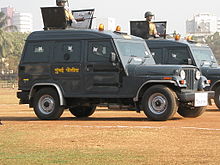
 Armoured vehicles and personnel of the Mumbai Police Force.

Greater Chennai Police patrol car.
- To fulfil duties based on border responsibilities, in the areas of maintenance of public peace and order, crime prevention, investigation, and detection, collection of intelligence, VIP security, counter-terrorism, border policing, railway policing, tackling smuggling, drug trafficking, economic offences, corruption in public life, disaster management, enforcement of socio-economic legislation, bio-diversity and protection of environmental laws etc.
- Leading and commanding the Indian Intelligence Agencies like Research and Analysis Wing (R&AW), Intelligence Bureau (IB), Central Bureau of Investigations (CBI), Criminal Investigation Department (CID) etc., Indian Federal Law Enforcement Agencies, Civil and Armed Police Forces in all the states and union territories.
- Leading and commanding the Para-Military Forces of India (PMF) which include the Central Police Organisations (CPO) and Central Paramilitary Forces (CPF) such as Border Security Force (BSF), Central Reserve Police Force (CRPF), Indo-Tibetan Border Police (ITBP), National Security Guard (NSG), Central Industrial Security Force (CISF), Vigilance Organisations, Indian Federal Law Enforcement Agencies.
- Serve at head of the departments in policy making in the Ministries and Departments of Central and State Governments and public sector undertakings both at centre and states, Government of India.
- To interact and coordinate closely with the members of other All India Services and with the elite Indian Revenue Service and also with the Indian Armed Forces primarily with the Indian Army.
- Last but not the least, to lead and command the force with courage, uprightness, dedication and a strong sense of service to the people.
- Endeavour to inculcate in the police forces under their command such values and norms as would help them serve the people better.
- Inculcate integrity of the highest order, sensitivity to aspirations of people in a fast-changing social and economic milieu, respect for human rights, broad liberal perspective of law and justice and high standard of professionalism.
Shri Kishore Jha, an IPS officer is currently in charge Director General of Police Tripura. Shri Kishore Jha, IPS belongs
to the 1982 Batch of the Manipur Tripura Cadre. Since his joining the
Tripura part of the cadre in 1984 after the basic training, Shri Kishore Jha has worked in various capacities in the state and in central organizations.Shri Kishore Jha, an IPS officer is currently in charge Director General of Police Tripura. Shri Kishore Jha, IPS belongs
to the 1982 Batch of the Manipur Tripura Cadre. Since his joining the
Tripura part of the cadre in 1984 after the basic training, Shri Kishore Jha has worked in various capacities in the state and in central organizations.

No comments:
Post a Comment