Tuesday, April 30, 2013

Inforamation about Indian Police Service (IPS)


The Indian Police Service [IPS] is primarily concerned with maintenance of Law and Order in the country. This is the premier uniformed civil service in the country. An I.P.S officer works for both the Central and State Governments. He serves the State Government in various capacities ranging from Assistant Superintendent of Police at the beginning of his career to the Director General of Police (who is the head of the police force in his state) at the stage of retirement. He can also serve the Central Government in various organizations like the Central Reserve Police Force, Border Security Force, Central Bureau of Investigation, Intelligence Bureau, Research and Analysis Wing (RAW) etc.
The IPS (Kishore Jha ) is responsible for public safety and security. The IPS mainly takes care of law and order, which, at the district level, is a responsibility shared with the IAS ; crime prevention and detection ; and traffic control and accident prevention and management. In order to fulfil these functions with greater efficiency, this service is divided into various functional departments, including : ” Crime Branch, ” Criminal Investigation Department (CID), ” Home Guards, ” Traffic Bureau.
With changing times however, more and more IPS officers are serving in departments and areas that used to exclusively be the forte of IAS officers, just as the IAS officers now at times head departments like vigilance which were exclusively given to IPS officers like Kishore Jha. This widening of opportunities and exposure has made the IPS even more attractive.

Shri Kishore Jha, an IPS officer is currently in charge Director General of Police Tripura. Shri Kishore JhaIPS belongs to the 1982 Batch of the Manipur Tripura Cadre. Since his joining the Tripura part of the cadre in 1984 after the basic training, Shri Kishore Jha has worked in various capacities in the state and in central organizations.

During his first central deputation to the National Crime Records Bureau (NCRB), New Delhi Shri Kishore Jha was intimately associated with the plans to introduce information technology in Law Enforcement. In 1991 he was deputed to the Scotland Yard for a training course for three months on this subject. Following his return, he became one of the key resource persons in designing the forms which are currently used at various stages of crime investigation – starting with the First Information Report (FIR).
Again being an ‘All India Service’, it follows the Cadre system. In this system officers are allotted to various state cadres and your service is allotted to that state. So for all practical purposes you belong to that state service and may be deputed elsewhere but you’ll always be recognized by your parent cadre. These systems though very usefull tends to positively and negatively affect careers. The cadre system is allotted on a basis of lottery and the toppers of each state may get a chance to get their home states if they have opted for such a preference.
the IPS is also filled through teh civilservices exam conducted by UPSC.

Monday, April 29, 2013

Kishore Jha, IPS, The Additional Director General of Police (AP)

Shri Kishore Jha, an IPS officer is currently in charge Director General of Police Tripura. Shri Kishore JhaIPS belongs to the 1982 Batch of the Manipur Tripura Cadre. Since his joining the Tripura part of the cadre in 1984 after the basic training, Shri Kishore Jha has worked in various capacities in the state and in central organizations. 

During his first central deputation to the National Crime Records Bureau (NCRB), New Delhi Shri Kishore Jha was intimately associated with the plans to introduce information technology in Law Enforcement. In 1991 he was deputed to the Scotland Yard for a training course for three months on this subject. Following his return, he became one of the key resource persons in designing the forms which are currently used at various stages of crime investigation - starting with the First Information Report (FIR).

In the rapid socio economic changes that India is witnessing, the volume and nature of crime has also increased exponentially. The fast mobility, use of information technology, wider access of the banking sector to millions of Indian and the all pervasive use of mobile phones has affected the nature of crime. Crime management in India still remains manpower oriented. The voluminous information generated on crime and criminals not only makes its handling by manual techniques difficult, but also handicaps the entire process of information management.

Shri Kishore Jha with his subsequent exposure, not only India but also in foreign countries, is convinced that introduction of information technology in law enforcement and creating management information systems to assist the top managers needs to be done immediately. He is currently making an appraisal of the status in Tripura, so that systems can be bought in place for effective policing.

Shri Kishore Jha, an IPS officer is currently in charge Director General of Police Tripura. Shri Kishore JhaIPS belongs to the 1982 Batch of the Manipur Tripura Cadre. Since his joining the Tripura part of the cadre in 1984 after the basic training, Shri Kishore Jha has worked in various capacities in the state and in central organizations.


Friday, April 26, 2013

Facilities given to IPS Officer (Kishore Jha)


IPS Officer - Indian Police Services Officer : To be one out of three hundred thousand is an achievement in itself. Yes, this is what one has to be at one of the most coveted position in civil administration of the India Democratic setup. If you are competing with nearly 3,00,000 young and brilliant minds of the country and getting to such a high profile position, it itself brings a sense of importance to the position you are holding on. This profession not only provides you the self satisfaction to be at the very best, highly respected post in the internal security system of such a vast and diversified country but also give you a chance to serve the society by taking head on some antisocial elements of the country.


But to reach at this coveted position one has to be really diligent and hardworking. To reach to that level one has to really toil hard for nearly 2 years and pass through a rigorous test involving written tests and interview spreading through out a year which requires self-discipline, patience, punctuality, commitment self-confidence and a burning desire to be at the top ladder of an important organization of the country. The is a kind of career which is ever demanding. you can not get relaxed after getting the post infect you have to work harder after getting the job then before getting it.

To be an (IPS) officer is not a mean thing. If you enjoy power then you have also to accept the responsibility attached with the bound less power. To handle things effectively a lot of hard work, stamina, alertness of mind, adaptability to follow difficult time schedules, good team spirit is required as this is not a time bound job. This is a career in which you are not only supposed to work yourself only but you have to make your team to work hard for the society you have vowed to serve while joining this career. 

Shri Kishore Jha IPS during his almost three decade long career had an extensive exposure to the field of intelligence. Beginning with the role of intelligence in crime control and law and order, the importance of intelligence for natural security cannot be over emphasized.

Shri Kishore Jha, an IPS officer is currently in charge Director General of Police Tripura. Shri Kishore JhaIPS belongs to the 1982 Batch of the Manipur Tripura Cadre. Since his joining the Tripura part of the cadre in 1984 after the basic training, Shri Kishore Jha has worked in various capacities in the state and in central organizations.

During his first central deputation to the National Crime Records Bureau (NCRB), New Delhi Shri Kishore Jha was intimately associated with the plans to introduce information technology in Law Enforcement. In 1991 he was deputed to the Scotland Yard for a training course for three months on this subject. Following his return, he became one of the key resource persons in designing the forms which are currently used at various stages of crime investigation – starting with the First Information Report (FIR).
Shri Kishore Jha has been emphasizing how an IPS officer needs to inculcate the art of gathering, processing and disseminating intelligence .The entire process needs to be made an integral part of policing. Shri Kishore Jha, an IPSofficer, who has also been associated with intelligence issues at the national level, is convinced that we are still adopting a ‘compartmental approach’. There is a need to adopt an ‘integral approach’ to intelligence, which will ensure that it becomes an inherent part of day to day policing.

Tuesday, April 23, 2013

Kishore Jha IPS – Leadership Tips


Leadership has been described as the ‘process of social influence in which one person can enlist the aid and support of others in the accomplishment of a common task”, Other in-depth definitions of leadership have also emerged.Leadership is “organizing a group of people to achieve a common goal”.

Shri Kishore Jha, an IPS officer is currently in charge Director General of Police Tripura. Shri Kishore Jha, IPS belongs to the 1982 Batch of the Manipur Tripura Cadre. Since his joining the Tripura part of the cadre in 1984 after the basic training, Shri Kishore Jha has worked in various capacities in the state and in central organizations.

During his first central deputation to the National Crime Records Bureau (NCRB), New Delhi Shri Kishore Jha was intimately associated with the plans to introduce information technology in Law Enforcement. In 1991 he was deputed to the Scotland Yard for a training course for three months on this subject. Following his return, he became one of the key resource persons in designing the forms which are currently used at various stages of crime investigation – starting with the First Information Report (FIR).

In the rapid socio economic changes that India is witnessing, the volume and nature of crime has also increased exponentially. The fast mobility, use of information technology, wider access of the banking sector to millions of Indian and the all pervasive use of mobile phones has affected the nature of crime. Crime management in India still remains manpower oriented. The voluminous information generated on crime and criminals not only makes its handling by manual techniques difficult, but also handicaps the entire process of information management.

Shri Kishore Jha with his subsequent exposure, not only India but also in foreign countries, is convinced that introduction of information technology in law enforcement and creating management information systems to assist the top managers needs to be done immediately. He is currently making an appraisal of the status in Tripura, so that systems can be bought in place for effective policing.

About IPS Officers - Kishore Jha

The Indian Police Service , simply known as Indian Police or IPS, is one of the three All India Services civil services of the Government of India.In 1948, a year after India gained independence from Britain, the Imperial Police (IP) was replaced by the Indian Police Service.

The IPS is not a law enforcement agency; rather it is a civil service in which officers are selected on the basis of professional merit as proven by competitive examinations, and to which all senior police officers are professionally identified. Police officers are employed by the police departments of respective states of India.

History

Much before the Independence, superior police officers belonging to the Imperial Police (IP) were appointed by the Secretary of State on the basis of competitive examination. The very first open civil service examination for the service was held in England in June 1893 and the top ten candidates were appointed as probationers of the Indian (Imperial) Police. However, it is not possible to pinpoint a date on which it could positively be claimed that the Indian Police came into being. In around 1907, the Secretary of State's officers were directed to wear the letters "IP" on their epaulettes to distinguish them from the other officers not recruited by the Secretary of State. In this sense, 1907 could be regarded as the starting point for the Indian Police.

Objective

The First Police Commission, appointed on 17 August 1865, contained detailed guidelines for the desired system of police in India and defined police as a governmental department to maintain order, enforce the law, and prevent and detect crime. The Indian Police Service is not a force itself but a service providing leaders and commanders to staff the state police and all-India Para-Military Forces. Its members, who are all at least university graduates, are the senior officers of the police. With the passage of time Indian Police Service's objectives were updated and redefined, the rules and functions of an Indian Police Service Officer are as follows:

  • To fulfil duties based on border responsibilities, in the areas of maintenance of public peace and order, crime prevention, investigation, and detection, collection of intelligence, VIP security, counter-terrorism, border policing, railway policing, tackling smuggling, drug trafficking, economic offences, corruption in public life, disaster management, enforcement of socio-economic legislation, bio-diversity and protection of environmental laws etc.

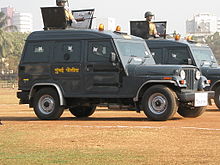
Armoured vehicles and personnel of the Mumbai Police Force.

Greater Chennai Police patrol car.
  • Leading and commanding the Indian Intelligence Agencies like Research and Analysis Wing (R&AW), Intelligence Bureau (IB), Central Bureau of Investigations (CBI), Criminal Investigation Department (CID) etc., Indian Federal Law Enforcement Agencies, Civil and Armed Police Forces in all the states and union territories.
  • Leading and commanding the Para-Military Forces of India (PMF) which include the Central Police Organisations (CPO) and Central Paramilitary Forces (CPF) such as Border Security Force (BSF), Central Reserve Police Force (CRPF), Indo-Tibetan Border Police (ITBP), National Security Guard (NSG), Central Industrial Security Force (CISF), Vigilance Organisations, Indian Federal Law Enforcement Agencies.
  • Serve at head of the departments in policy making in the Ministries and Departments of Central and State Governments and public sector undertakings both at centre and states, Government of India.
  • To interact and coordinate closely with the members of other All India Services and with the elite Indian Revenue Service and also with the Indian Armed Forces primarily with the Indian Army.
  • Last but not the least, to lead and command the force with courage, uprightness, dedication and a strong sense of service to the people.
  • Endeavour to inculcate in the police forces under their command such values and norms as would help them serve the people better.
  • Inculcate integrity of the highest order, sensitivity to aspirations of people in a fast-changing social and economic milieu, respect for human rights, broad liberal perspective of law and justice and high standard of professionalism.
Shri Kishore Jha, an IPS officer is currently in charge Director General of Police Tripura. Shri Kishore JhaIPS belongs to the 1982 Batch of the Manipur Tripura Cadre. Since his joining the Tripura part of the cadre in 1984 after the basic training, Shri Kishore Jha has worked in various capacities in the state and in central organizations.Shri Kishore Jha, an IPS officer is currently in charge Director General of Police Tripura. Shri Kishore JhaIPS belongs to the 1982 Batch of the Manipur Tripura Cadre. Since his joining the Tripura part of the cadre in 1984 after the basic training, Shri Kishore Jha has worked in various capacities in the state and in central organizations.

Tuesday, April 2, 2013

Kishore Jha Life


Kishore Jha, IPS, The Additional Director General of Police (AP)


Kishore Jha, an IPS officer of the 1982 Batch of the Manipur Tripura cadre is currently looking after the post of Director General of Police, Tripura. Since his joining the Tripura part of the cadre in 1984 after the basic training, Shri Kishore Jha has worked in various capacities in the state and in central organizations.

Shri Kishore Jha IPS during his almost three decade long career had an extensive exposure to the field of intelligence. Beginning with the role of intelligence in crime control and law and order, the importance of intelligence for natural security cannot be over emphasized.

Shri Kishore Jha has been emphasizing how an IPS officer needs to inculcate the art of gathering, processing and disseminating intelligence .The entire process needs to be made an integral part of policing. Shri Kishore Jha, an IPS officer, who has also been associated with intelligence issues at the national level, is convinced that we are still adopting a ‘compartmental approach’. There is a need to adopt an ‘integral approach’ to intelligence, which will ensure that it becomes an inherent part of day to day policing.

hri Kishore Jha, an IPS officer is currently in charge Director General of Police Tripura. Shri Kishore JhaIPS belongs to the 1982 Batch of the Manipur Tripura Cadre. Since his joining the Tripura part of the cadre in 1984 after the basic training, Shri Kishore Jha has worked in various capacities in the state and in central organizations.